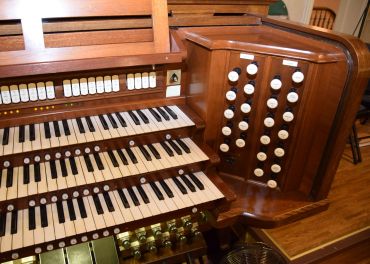
1911/1997 Durner/Crosson-Savage, III/36

Union United Church of Christ, Neffs, PA
Photo Gallery
Stop List
History
The organ has always been a vital part of our church. Only twenty years after our first church building was erected by brethren of the Reformed faith in 1755, a new organ was purchased for this, The Log Church.
A member of the congregation named Burkhalter graciously offered himself and his team of horses to deliver the new organ to the church, free of charge. He safely loaded the organ at the place where it was purchased; but enroute back to the church, the horses were frightened and ran away, smashing this new first organ to bits. It is not known whether it was immediately replaced.
Forty-one years later, on May 27, 1796, the corner stone for the new Stone Church was laid, and the building finally completed in 1797. Worship services continued there until April 16, 1871, when the last service was held, and work immediately began to dismantle the old building.
With the old building removed, the opening of the corner stone, which was to be the repository of the early church records prior to 1797, was a sad disappointment, when it was opened it was found to be empty. It is believed that records of the early organ may have been stored in this vessel.
It is recorded however, that a new pipe organ was purchased for use in the Stone Church in 1821 and was used there for fifty years. In 1872 it was rebuilt and moved to the then new Brick Church. It was installed in an archway along the rear wall of the present choir loft. The console and the organist faced the pulpit.
The air supply for the 1872 organ was manually operated by a member of the congregation. This person, who for a very nominal payment of a few cents each Sunday, would sit behind the console in the organ chamber, out of view of the congregation and manually pump the organ bellows. This employee of the church was known as the "pumper." It was said that on occasion he would fall asleep, and all were embarrassed when the organ was inoperable for the next hymn.
In 1902 it was again necessary to make major repairs to the 1872 pipe organ.
On April 21, 1911, at a special meeting of the joint consistory of the Unionville Church, the members voted to have a new organ installed, with the restriction that all expenses be prepaid by the congregation. The matter of installing a new organ was presented to the joint congregations on April 29, 1911.
In order to raise the necessary funds to purchase this instrument, it was decided to tax each church member, male or female, one dollar. Further to this it was decided to levy a tax against all property owners belonging to the church, an amount sufficient to pay the total cost of $3500.00 for the organ and the motor to drive it. An electric line was run from the trolley wires to the church specifically to power the motor for the organ air supply.
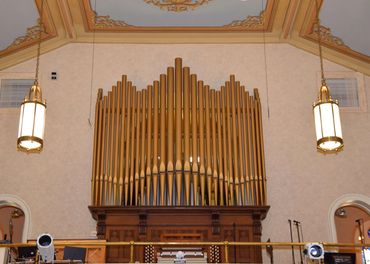
In 1911 a new two manual, tracker organ was purchased from the Durner Organ Company of Quakertown, Pennsylvania. New pipes were installed on the rear wall of the choir loft and the lower portion of the wall was paneled as it is today. The new organ console was placed immediately under the pipe "fence" with the console now facing the wall.
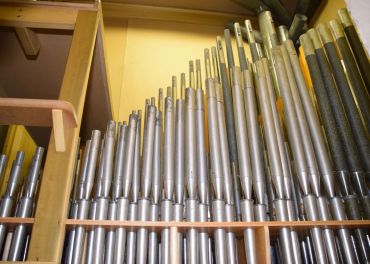
While most of the pipes we see in the pipe "fence" above the choir loft are merely a facade, some were actual working pipes. The real pipes, however, are concealed in the organ chamber behind the choir loft, in the tower.
It is interesting to note that the dedication, on May 12, 1912, eighty-five years ago, was that of a morning and afternoon service. Sermons and addresses were made by fourteen pastors, nine of which were sons of the congregation.
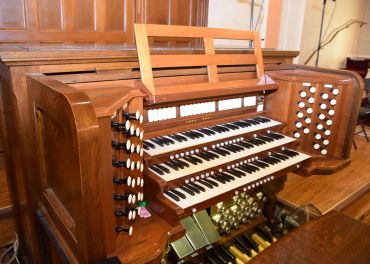
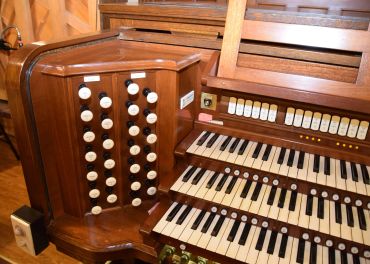
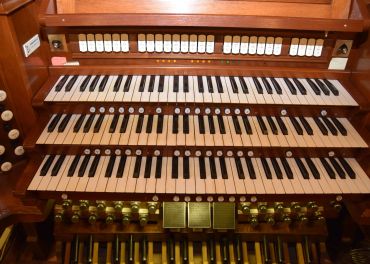
Circa 1940, the 1911 Durner was again refurbished. The key and stop actions of the wind chest were converted to Electro-pneumatic operation and a new Electro-pneumatic choir chest and pipes were added along with a new three manual console. The organ was expanded to twenty-two ranks -- 1200 plus pipes. The console was moved forward to its present location along the balcony rail of the choir loft. The loft can comfortably seat approximately thirty-eight choir members.
On June 7, 1994, an organ committee was formed. The mission of the committee was to determine what feasible plan could be implemented to restore or replace this historic treasure, rapidly deteriorating, but ever so vital to our worship service, and raise the necessary funds for the project.
There were only three options the committee could pursue:
- Update, overhaul and otherwise rebuild our present instrument which then would again serve the congregation another sixty to seventy-five years.
- Purchase a completely new organ.
All would require time, of which there was little, and money, of which there was none.
The committee carefully studied their options:
- It was determined that the rapidly deteriorating condition of the present organ was beyond “band-aid” repairs.
- Should a new organ be considered and a new organ was to be purchased, should it be another pipe organ or should it be an electronic organ?
Organ companies were contacted and their expertise and advice sought. Other churches, where new or rebuilt installations were made, were visited and finally a decision reached that an electronic organ would not aesthetically compliment the historic grandeur of our sanctuary and historic church. Further to this, the cost of a completely new pipe organ was prohibitive. Accordingly, then, the decision was made to rebuild and completely restore the fine instrument that was ours.
Requests for information, specifications and prices were made to three reputable pipe organ builders along with a request to a leading electronic organ builder for comparison purposes.
Bids were received to completely rebuild and refurbish the organ at a cost of approximately $230,000.00. This proposal was presented to the Board of Governors on January 18,1995 and accepted as a Union Church project. The organ committee was given approval to solicit funds for this project. A stipulation was made, however, that 80% of the funds be available prior to the signing of an agreement with the organ builders.
Since the refurbishing of the organ was to cost approximately $230,000 which included doubling the number of pipes in the 1911 Durner organ from 1200 to 2400, an idea was conceived by a member of the committee, Mrs. Debbie Geiger, that if the organ was to have 2400 pipes and each pipe could be sold for $100 each, as an honorarium or memoriam to loved ones, the goal would be achieved, with perhaps, additional funds to cover unforeseen contingencies. The committee unanimously approved the idea and the capital fund campaign was launched. The 1872 Organ Fund was established and a special account opened for this purpose.
On May 21, 1995, at a joint congregational meeting, members of both congregations approved the restoration of the 1911 Durner organ and a contract was awarded to Crossan-Savage, Inc of Cedars, Pennsylvania on December 13, 1995.
As of April 1, 1997, the entire amount has been raised. There were no expenses incurred to either the Lutheran or United Church of Christ congregations.
This website uses cookies.
We use cookies to analyze website traffic and optimize your website experience. By accepting our use of cookies, your data will be aggregated with all other user data.